


GAGomes as early detection biomarkers: multi-cancer
Recent evidence suggests that metabolic reprogramming of GAGomes is an ubiquitous process in cancers. In a clinical study with over...
Our initial research focused on renal cell carcinoma (RCC) – the most common form of kidney cancer. In RCC, it was observed a unique deregulation of glycosaminoglycan metabolism (Gatto et al., 2016). This was posited to define a signature of the GAGome specific to RCC.
In an initial proof of concept study, a GAGome signature was indeed detected non-invasively in the plasma and urine of metastatic RCC patients revealing exceptional changes compared to normal healthy levels (Gatto et al., 2016). Another clinical study conducted at the Memorial Sloan Kettering Cancer Center, NY, confirmed this finding in non-metastatic RCC making the GAGome a promising system biomarker for early cancer detection (Gatto et al., 2018).
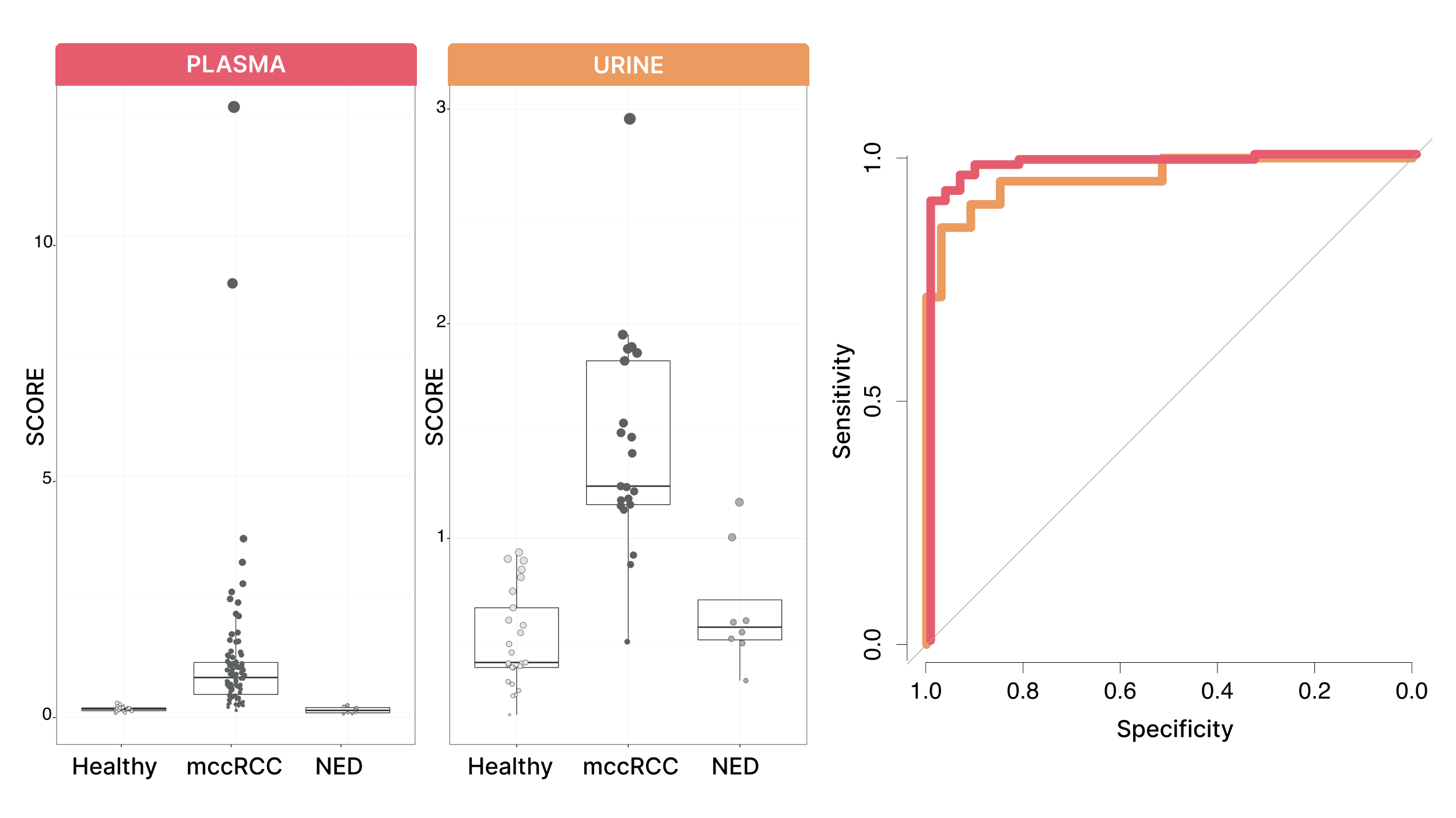
GAGome signatures in the plasma and urine captured in so called GAG scores and compared between healthy, metastatic clear cell renal cell carcinoma (mccRCC) and no evidence of disease (NED) patients. Corresponding ROC curves for each fluid are shown on the right. Adapted from Gatto et al., 2016.
Two prospective clinical studies at Sahlgrenska University Hospital, Sweden explored the potential of GAGomes specifically in RCC patients at risk of post-surgical recurrence (Gatto et al., 2022) as well as in patients with metastatic RCC to monitor and predict progression (Gatto et al., 2023).
Elypta evaluated a urine GAG-based configuration for ccRCC recurrence after curative-intent surgery in AURORAX-0087A (AUR87A). The locked Cohort 2 configuration was based on three chondroitin sulfate disaccharides as analytical inputs, whereas earlier GAG test configurations used a broader 17-analyte panel. The test configuration evaluated in Cohort 2 did not meet the prespecified criteria for clinical validation for this intended use: AUR87A Cohort 2 results.
Page updated 27 August 2026.

.svg)


ISO 13485:2016 certified for Design, development and manufacture of in vitro diagnostic test kits and software for the measurement and interpretation of glycosaminoglycans (GAGs) in human biofluids


