GAGome Kit Evolution & Publications

2015-19: Biomarker discovery phase

Prototype lab-developed assay

GAGome academic grade-assay established in Volpi Lab at the University of Modena and Reggio Emilia, Italy. It determines the composition of 17 CS, HS and HA GAG disaccharides in the total glycosaminoglycan fraction in urine and plasma using capillary electrophoresis
Renal Cell Carcinoma
Lung cancer
Other (multi-cancer, MPS)
Kit & Analytical performance

2016

Glycosaminoglycan Profiling in Patients’ Plasma and Urine Predicts the Occurrence of Metastatic Clear Cell Renal Cell Carcinoma Cell Reports Cell Reports

Diagnostic biomarker discovery study in metastatic ccRCC, showed coordinated regulation of GAG biosynthesis

2016

Prognostic value of plasma and urine glycosaminoglycan scores in clear cell renal cell carcinoma Frontiers in Oncology

GAGome alterations correlated with survival in metastatic ccRCC providing prognostic biomarker proof-of-concept

2018

Plasma Glycosaminoglycans as Diagnostic and Prognostic Biomarkers in Surgically Treated Renal Cell Carcinoma European Urology Oncology

Alterations from normal levels in early-stage RCC provides diagnostic biomarker proof-of-concept

2020: First Generation high-throughput research kit

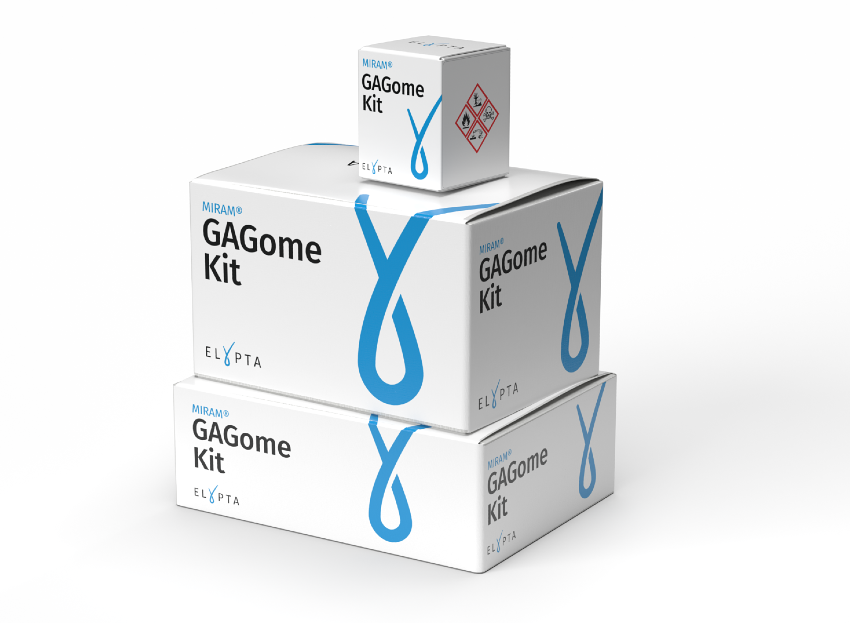
MIRAM GAGome Kit – Gen 1

Code: FRUOV1 - The first standardized and high-throughput GAGome research-grade kit measuring the protein-free fraction of all 17 GAGs on mass spectrometry (specifically, UHPLC-MS/MS, Waters® Acquity I-class Plus Xevo TQ-S micro)
Renal Cell Carcinoma
Lung cancer
Other (multi-cancer, MPS)
Kit & Analytical performance

2021

Analytical performance of a standardized kit for mass spectrometry-based measurements of human glycosaminoglycans J. Chromatogr

Established the analytical performance of the 1st gen GAGome kit

2022

Analysis of normal levels of free glycosaminoglycans in urine and plasma in adults J. Biol. Chem.

First baseline study in a general population on a standardized GAGome kit

2022

Plasma and Urine Free Glycosaminoglycans as Monitoring Biomarkers in Nonmetastatic Renal Cell Carcinoma—A Prospective Cohort Study Eur. Uro. Open Science

First prospective single-center study providing proof-of-concept for GAGome as monitoring biomarkers in RCC

2022

Noninvasive detection of any-stage cancer using free glycosaminoglycans PNAS

First proof-of-concept study demonstrating early stage sensitivity to 14 cancer types in an asymptomatic population

2023

Plasma and Urine Free Glycosaminoglycans as Monitoring and Predictive Biomarkers in Metastatic Renal Cell Carcinoma: A Prospective Cohort Study JCO Precis Oncol

First prospective single-center study providing proof-of-concept for GAGome as response monitoring biomarkers in RCC

2023

Mucopolysaccharidoses Differential Diagnosis by Mass Spectrometry-Based Analysis of Urine Free Glycosaminoglycans—A Diagnostic Prediction Model Biomolecules

Proof-of-concept study on GAGome scores as biomarkers to differentiate between MPS subtypes

2024

High-throughput glycosaminoglycan extraction and UHPLC- MS/MS quantification in human biofluids Nature Protocol

Describes the development approach behind the first high-hroughput and standardized GAGome kit

2022: Improved scalability of profiling kit

MIRAM GAGome Kit – Gen 2

Code: FRUOV2 - The second improved version of the GAGome research-grade kit (FRUOV2) measuring the protein-free fraction of all 17 GAGs on mass spectrometry (UHPLC-MS/MS, Waters® Acquity I-class Plus Xevo TQ-S micro)
Renal Cell Carcinoma
Lung cancer
Other (multi-cancer, MPS)
Kit & Analytical performance

2024

Urinary Free Glycosaminoglycans Identify Adults at High Risk of Developing Early-stage High-grade Bladder Cancer Eur. Uro. Open Science

Retrospective validation study on GAGome as risk-stratification markers in bladder cancer

2024

Discriminating Benign from Malignant Lung Diseases Using Plasma Glycosaminoglycans and Cell-Free DNA Int. J. Mol. Sci.

Proof-of-concept study developing a plasma-based lung-cancer score showing elevated early-stage sensitivity compared with cfDNA

2025

External Validation of Plasma Glycosaminoglycans as Biomarkers to Improve Lung Cancer Risk Stratification Cancer Epidemiol Biomarkers Prev.

Retrospective validation of a plasma-based lung cancer GAGome score to improve on LLPv3 risk model in a symptomatic population

2024: Branched off high-quality CS kit

MIRAM GAGome Kit – Gen 2

Code: IVDUV1 & FRUOU-CS (released for research use only in 2026): These kits, developed to meet the highest standards for quality and precision, quantify the protein-free fraction of the three most abundant CS disaccharides in urine on mass spectrometry (UHPLC-MS/MS, Waters® Acquity I-class Plus Xevo TQ-S micro). They include all key reagents, calibrators, internal standards, and QCs and are intended to support translational research.
Renal Cell Carcinoma
Lung cancer
Other (multi-cancer, MPS)
Kit & Analytical performance

2025

Multi-cancer risk prediction in asymptomatic adults using urinary glycosaminoglycan profiling ASCO 2025 Abstract

Proof-of-concept study on GAGome as multi-cancer risk stratification biomarkers on a 5-year time horizon before diagnosis

2025

Urine Glycosaminoglycan Scores for Surveillance of Recurrence in Intermediate- and High-risk Nonmetastatic Clear Cell Renal Cell Carcinoma—An Observational Prospective Multicentre Diagnostic Test Cohort Study European Urology Oncology

Multi-center international development study in ccRCC recurrence surveillance (AUR87A Cohort 1)

2025

[Manuscript in preparation: AUR87A Cohort 2 (reported Aug-26)]

2025

[Manuscript in preparation: Analytical validation of FRUOU-CS]

MIRAM GAGome kit – Gen 3
(coming soon)

The 3rd generation GAGome kits will measure the protein-free fraction of 11 or more CS, HS & HA GAG disaccharides with quality and precision required to support translational research. The kit will come in versions varying in analyte scope & matrices and are optimized to run on the new Waters® Acquity I-class Plus Xevo TQ Absolute XR (or similar performance mass spectrometers), enabling over 100x Lower Limit of Quantification versus previous generations.

Commercial release targeted in 2027.